With every new medium, the same question comes back. AI is just the latest stage of a very old rocket.
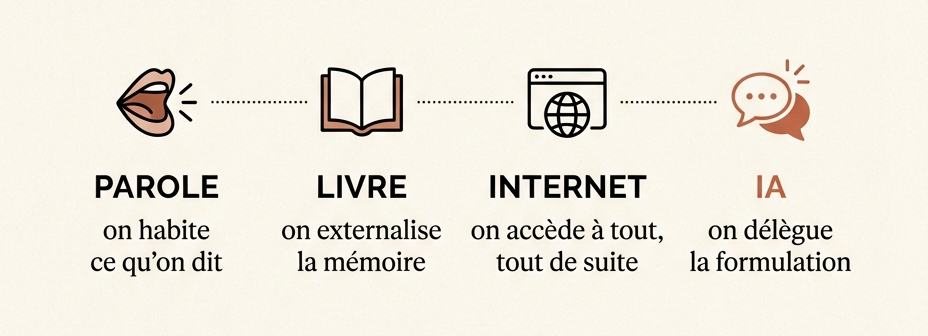
An old debate: speech → books → internet → AI Link to heading
- Speech. Before anything else, knowledge lived in memory and voice. To pass it on was to inhabit what you said, in front of someone, in person.
- Books. Writing externalized memory. Plato, in the Phaedrus, was wary of it: he saw it as false wisdom, knowledge consulted but no longer truly understood.
- The internet. Access became instant and global. We feared intellectual laziness, superficiality, the loss of any real capacity to dig deep.
- AI. We no longer consult — we order. Knowledge is shaped on demand, for us, in a few seconds. The fear is the same: what do we lose when we delegate not just memory, but formulation itself?
None of these media has ever replaced the previous one. They stacked on top of each other. But each time, what we expected from the human shifted.
Rather than a long debate, here is my concrete, practical take.
What AI does well Link to heading
- Instant formatting: structure, outline, transitions, clean subheadings.
- Plain-language explanation: clearly translates a technical concept for a non-specialist.
- Quick drafts: turning a vague idea into presentable text in minutes.
- Documentation and tutorials: ideal territory — what you need is clarity, not a singular voice.
- Rephrasing: shortening, adjusting tone, translating, correcting.
- Infographics and illustrations: instant professional visual presentation.
- Removing technical friction: spelling, syntax, layout.
In short: AI instantly writes what an average human would write correctly after several hours.
What it does less well Link to heading
- Lived anecdote: it describes generic experience, never yours.
- Non-conventional opinion: it converges toward the average — it won’t risk an uncomfortable view or a clunky-but-honest phrase.
- Voice: an AI text is smooth, therefore forgettable.
- Contextual nuance: it doesn’t know what’s really at stake in your company, your industry, your situation.
- True originality: it recombines — it doesn’t invent.
- Raw emotion: it simulates, it doesn’t feel.
Which AI content can I consume (without dulling myself)? Link to heading
My personal sorting:
- ✅ Technical documentation, tutorials, plain-language explanations → generally very good.
- ✅ Summaries, syntheses, comparisons → useful to break ground on a topic.
- ✅ Translations and rephrasing → often better than a rushed human.
- ⚠️ “Generalist” blog posts → skim them, don’t expect much. The knowledge is correct, the voice is absent.
- ⚠️ Marketing content → functional but saturated — everyone produces the same thing.
- ❌ Opinion essays, testimonials, personal experience reports → avoid if purely AI-generated. This is where AI is weakest and where you’ll be bored fastest.
- ❌ Any content pretending to be a human experience without being one → dishonest, and often detectable.
Simple rule: if I’m looking for information, AI does the job. If I’m looking for a point of view, I want a human behind it.
The value of having everything “on demand” Link to heading
- Instant access: no more spending 20 minutes searching just to understand a concept.
- Adapted to your level: you can ask for the simple version, the technical one, or the advanced one.
- No social friction: you can ask the “dumb” questions you’d never ask a human.
- Available 24/7, free or nearly so: it’s a revolution in access to knowledge comparable to the internet itself.
- Personalized learning: AI answers your question, not an average audience’s.
This is probably AI’s biggest contribution — and the one we underestimate the most, because it has already become invisible.
Biases and problems (in brief) Link to heading
To keep in mind, without panicking:
- Homogenization of discourse: if everyone writes with the same AI, everything ends up sounding alike.
- Hallucinations: AI sometimes invents facts with full confidence. Always verify.
- Training data bias: it reflects the blind spots of the corpus it learned from.
- Cognitive dependence: by outsourcing writing and thinking, we may be losing a muscle.
- Disinformation at scale: producing believable false content has never been easier.
- Ecological and ethical questions: energy cost, training conditions, copyright over data.
Each of these would deserve its own article — that’s for later.
My take Link to heading
AI writes average, fast, and well. Depending on context, that’s exactly what you need — or exactly what destroys meaning.
I use it without hesitation when the goal is to communicate clearly. But when I write something that has to sound like me — an opinion, an anecdote, a text where I put myself on the line — I keep my hands on the keyboard. The rest, I’m fine delegating.