Hugo Framework: fast, lightweight, efficient
History of my personal websites Link to heading
I recently redesigned my freelance showcase website. This isn’t just an update, but a real change of direction.

The first version of my site was built on Django. Solid, but heavy. Deployment was slow, dependencies numerous, and I spent more time configuring than publishing. I needed something simpler, faster. That’s when I discovered Hugo.
Express setup with Hugo and Copilot Link to heading
Thanks to GitHub Copilot, I was able to set up the new version of my site in just 5 hours. Everything is generated in static HTML, which makes deployment almost instantaneous: half a second, stopwatch in hand. Content generation by AI tools requires a lot of proofreading and human adaptation, and even after that, leaves a “chatGPT”/non-human identity that I don’t like very much.
The content? Written in Markdown. Structured data? In YAML — perfect for my “projects” page. The design? Based on a default theme, like on WordPress, but totally customizable.
In summary: Hugo is the lightness of a static framework, the power of customization, and unbeatable hosting simplicity. It’s exactly what I needed for my site in 2025.
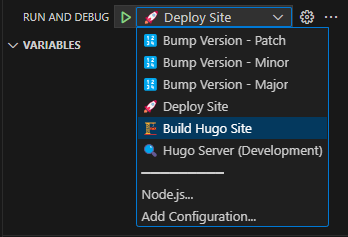
Following the request, Copilot also added scripts to automate the versioning and deployment part. After some adjustments, I get
Hugo vs WordPress Link to heading
As a coder, I enjoy working with files in VSCode, in markdown, and being able to work with low-level web technologies.
For someone who doesn’t code, I would recommend WordPress today.
A suitable choice… but not universal Link to heading
This is certainly not the right choice for all web projects, but in my case, Hugo allowed me to refocus on the essential: writing and sharing.
For a personal showcase in 2025, it’s hard to go faster. And you, what stack did you choose?